
 Tea information
  Tea classification
  Tea effect
  tea price
  How to drink tea
  tea cultivation
  Tea tasting tea ceremony
  Tea Q&A
  history and culture
  Home
HomeThe origin of Hanajuan tea, which is passed down from male to female | free slots no deposit keep winnings, link judi slot terbaru, bonus rollingan togel
Huajuan tea was originally named "Bailiang Tea", which means that the net weight of a roll (branch) of tea is 100 taels (in the old Sima name, one catty is sixteen taels). Later, it developed into "Qianliang Tea", that is, a roll (branch) of tea, and the net weight of each stick is Laochang's thousand taels. Generally, Qianliang tea is about 1.5 meters long and 60 centimeters in diameter. There is a kind of "fungus flower" growing inside the body of some Hanajuan tea teas, which has been confirmed to be "Corontocystis coronalis". The production of Huajuan Tea requires sifting, sorting, shaping, and stacking procedures in the selection of raw materials. In terms of processing, it requires twisting, pressing, stamping, rolling, and hammering techniques. It is wrapped with polygon leaves, wrapped with palm flakes, and then bundled with bamboo strips to tighten it into a cylindrical shape. It was founded in Jiangnan Town, Anhua. The production method is controlled by a few people named Liu, and it is stipulated that it can only be passed down to men and not to women. Pu'er tea quotation platform!
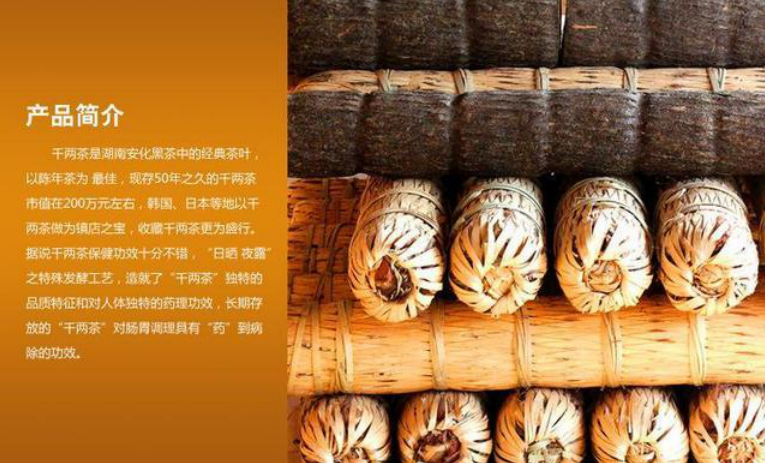
Around 1820 (the first year of Daoguang), Shaanxi tea merchants stationed in Yiyang entrusted the bank to remit money to Anhua to order black tea, or exchange wool and fur coats for it; the bank hired people to go to the countryside to purchase tea raw materials, bundle them into bags, called "Lihe tea", and then stamp them into cylindrical shapes, which is called "Bailiang tea". During the Tongzhi period, Shanxi Shang's "Sanhe Gong" tea brand selected better raw materials based on Bailiang tea, increased its weight, and pressed brown silk, rice dumpling leaves and bamboo strips into flower rolls. Each roll had a net weight of one thousand liang, also known as "Qianliang tea".
In 1952, Baishaxi Tea Factory invited technicians into the factory to teach apprentices the art, and they mastered the production technology of Huajuan tea, making Baishaxi Tea Factory the exclusive manufacturer of Huajuan tea.
In 1958, because the production of Huajuan tea was very complicated and the transportation was inconvenient, production was stopped, and machine-pressed Huajuan tea was used instead. In 1983, Baishaxi Tea Factory feared that the Huajuan Tea technique would be lost, so it hired technicians to return to the factory and lead a group of young technicians to participate in the production and pass on the skills, producing more than 300 "Qianliang Tea". In 1997, in order to meet market demand, Baishaxi Tea Factory resumed the production of traditional Huajuan tea.
{"@context":"https://schema.org","@type":"Article","headline":"The origin of Hanajuan tea, which is passed down from male to female | guangxi, liubao, tea","name":"The origin of Hanajuan tea, which is passed down from male to female | guangxi, liubao, tea","description":"Huajuan tea was originally called Bailiang tea, that is, the net weight of one roll (branch) of tea is 100 taels (in the old Sima name, one catty is sixteen taels). Later, it developed into \"Qianliang tea\", that is, one roll (branch) of tea, and the net weight of each stick is Laocheng's thousand taels. Generally, Qianliang tea is about 1.5 meters long and 60 centimeters in diameter. department Topics: guangxi, liubao, tea.","url":"https://marqulo.com/chayefenlei/62.html","datePublished":"2020-03-31T16:59:45+08:00","dateModified":"2026-07-01T18:21:19+08:00","author":{"@type":"Organization","name":"Editorial Team"},"publisher":{"@type":"Organization","name":"marqulo.com"},"mainEntityOfPage":{"@type":"WebPage","@id":"https://marqulo.com/chayefenlei/62.html"},"speakable":{"@type":"SpeakableSpecification","cssSelector":[".key-answer","h1","h2"]},"about":{"@type":"Thing","name":"The origin of Hanajuan tea, which is passed down from male to female | guangxi, liubao, tea","description":"Huajuan tea was originally called Bailiang tea, that is, the net weight of one roll (branch) of tea is 100 taels (in the old Sima name, one catty is sixteen taels). Later, it developed into \"Qianliang tea\", that is, one roll (branch) of tea, and the net weight of each stick is Laocheng's thousand taels. Generally, Qianliang tea is about 1.5 meters long and 60 centimeters in diameter. department Topics: guangxi, liubao, tea."},"inLanguage":"en-ID","contentLocation":{"@type":"Place","name":"Indonesia","address":{"@type":"PostalAddress","addressCountry":"ID"}}}
Latest updates
- How to Choose the Right Game for Your Console: A B
- Exploring the Best Mobile Games of 2023: Android a
- Exploring the Best PC Game Downloads on Steam and
- Upcoming Indie Games to Look Forward to in 2023: A
- Maximize Your Gaming Experience on PC: Tips for Do
- Exploring the Future of Gaming: 2023 and Beyond |
- Unlock Endless Fun: Your Guide to Downloading the
- Upcoming Games to Watch for on Console and PC This
- 5 Best Indie Games to Download on PC in 2024 | rtp
- The Future of Mobile Downloads: What Gamers Need t
Recommended reading
You May Also Like
- How to Optimize Your Game Download Speeds | situs
- Game Downloads Made Easy: Your Comprehensive Guide
- Get Ready for the Gaming Revolution: Top Game Down
- Exploring the World of Console Game Downloads in 2
- Explore the Upcoming Lords of the Fallen: What You
- The Impact of Game Updates: Why Downloading the La
- Best Free Games to Download on Steam in 2024 | rtp
- Exploring Indie Games: Hidden Gems to Download Now
- The Best Game Downloads on Console: A 2023 Review
- The Best Cross-Platform Games to Download for Endl
Follow us